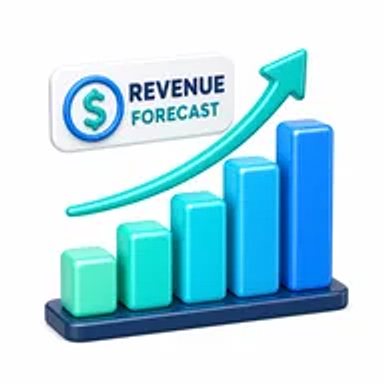
Revenue forecast calculator showing sales volume average price growth assumptions and projected monthly business revenue

Revenue Forecast Calculator Online for Free

Estimate future revenue from customer volume, units sold, average price, subscriptions, growth assumptions, or supported business inputs. Compare conservative, expected, and ambitious scenarios.

Enter values, then tap Calculate

Why Revenue Forecasting Matters

Revenue forecasts help businesses plan hiring, inventory, marketing, funding, capacity, and cash needs. They translate assumptions about customers, units, prices, conversion, retention, and timing into a structured financial view.

A forecast is not a promise. Revenue can differ because of seasonality, cancellations, discounts, delays, collection risk, competition, economic changes, product capacity, and weak assumptions. Forecasts should be updated when actual results become available.

How Hemiley Builds a Revenue Forecast

Enter the supported sales drivers for the business model, such as units sold and average price, customers and average revenue, or recurring revenue and growth. Choose the period and compare projected totals.

Use consistent definitions and avoid counting the same revenue twice. If invoices are issued before or after cash is collected, remember that revenue forecasting and cash-flow forecasting are related but different activities.

Key Benefits

  • Driver-based planning

    Connect revenue to measurable assumptions rather than entering one unexplained total.

  • Scenario comparison

    Create conservative, expected, and ambitious cases.

  • Growth visibility

    See how customer, unit, price, churn, or expansion assumptions affect future totals.

  • Planning support

    Use forecasts when considering hiring, inventory, marketing, and funding needs.

  • Performance review

    Compare forecast values with actual results and revise assumptions.

  • Browser-based access

    Build quick revenue scenarios without starting a spreadsheet from zero.

Who Uses This Business Tool?

  • Startup founders

    Prepare early sales scenarios for funding and launch planning.

  • Small-business owners

    Estimate monthly, quarterly, seasonal, or annual revenue.

  • Sales and marketing teams

    Connect lead, conversion, price, and customer targets to revenue.

  • Product and subscription teams

    Model recurring revenue, retention, expansion, and customer growth.

  • Students and advisers

    Prepare financial projections for business plans and case studies.

How to Forecast Revenue in 4 Steps

  1. 1

    Choose the business driver.

    Use units, customers, contracts, subscriptions, locations, or another measurable sales basis.

  2. 2

    Enter price and volume assumptions.

    Use expected net price, realistic capacity, conversion, retention, and timing.

  3. 3

    Build several scenarios.

    Create conservative, expected, and ambitious cases instead of relying on one result.

  4. 4

    Compare with actuals.

    Update the forecast regularly and explain differences between expected and realised performance.

Common Use Cases

  • Estimate monthly revenue for a retail or e-commerce business.
  • Model subscription revenue from new customers, churn, and average monthly value.
  • Forecast agency revenue from projects, retainers, and available capacity.
  • Compare revenue impact from price changes and sales-volume changes.
  • Prepare a three-year revenue section for a business plan.
  • Test whether a marketing, hiring, or inventory plan is supported by plausible sales assumptions.

Why Choose Hemiley?

Hemiley helps convert sales assumptions into readable revenue scenarios that can support planning, discussion, and periodic review.

The calculator does not predict demand, validate market size, guarantee sales, model every accounting rule, estimate profit automatically, or replace a complete cash-flow and financial forecast.

Frequently Asked Questions

It is an estimate of future sales revenue based on defined assumptions about volume, customers, price, timing, growth, or other business drivers.

Use a horizon appropriate to the decision. Monthly detail may be useful for the next year, while longer plans often use quarterly or annual summaries.

Use the accounting and planning definition appropriate to your business. Many forecasts use net sales excluding taxes collected on behalf of authorities.

No. Credit terms, deposits, prepayments, refunds, and late payments can make cash collection occur at a different time from revenue recognition.

Use market evidence, capacity, pricing, conversion tests, comparable benchmarks, and conservative scenarios, then update quickly with actual results.

Different scenarios make uncertainty visible and help the business prepare actions for slower or faster performance.