
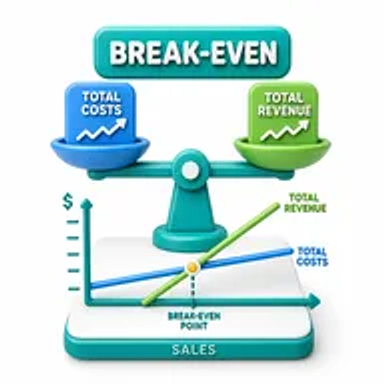
Why Break-even Analysis Matters
A business can generate sales and still lose money when its contribution from each sale is not enough to cover rent, salaries, software, insurance, equipment, and other fixed costs. Break-even analysis connects pricing, cost structure, and sales volume in one simple planning model.
For a single product, the basic unit formula is fixed costs divided by contribution per unit, where contribution per unit equals selling price minus variable cost. The result is an estimate, not a guarantee, because demand, discounts, taxes, returns, capacity, product mix, and cash timing can change the real outcome.
How Hemiley Calculates the Break-even Point
Enter fixed costs for the selected period, the selling price per unit, and the variable cost per unit. Hemiley calculates contribution per unit and estimates the number of units required to cover the entered fixed costs.
Where supported, the calculator may also estimate break-even revenue. Use values from the same time period and define costs consistently. For a multi-product business, a simple single-product calculation may not reflect changing sales mix.
Key Benefits
Clear sales target
Estimate the minimum unit volume required before accounting profit becomes positive.
Pricing scenarios
See how a higher or lower selling price changes the break-even point.
Cost sensitivity
Test the effect of rent, payroll, materials, packaging, commissions, and other costs.
Contribution visibility
Understand how much each sale contributes toward fixed costs and profit.
Launch planning
Compare whether a product idea appears achievable at expected demand levels.
Browser-based access
Run quick scenarios without building a spreadsheet from the beginning.
Who Uses This Business Tool?
Startup founders
Estimate the sales volume needed for a new product or service.
Small-business owners
Review pricing, costs, and expansion decisions.
Freelancers and agencies
Estimate how many projects or billable units are needed each month.
Product managers
Compare launch assumptions and contribution economics.
Students and educators
Learn fixed cost, variable cost, contribution margin, and break-even concepts.
How to Calculate Break-even in 4 Steps
- 1
Choose one period.
Use monthly, quarterly, or annual values consistently.
- 2
Enter fixed costs.
Include costs that do not change directly with each unit sold for that period.
- 3
Enter price and variable cost.
Use the expected net selling price and the incremental cost per unit.
- 4
Review the result.
Compare break-even units with realistic capacity and demand, then test alternative scenarios.

Common Use Cases
- Estimate how many subscriptions are needed to cover monthly operating costs.
- Calculate the number of products a shop must sell before earning operating profit.
- Compare two suppliers with different unit costs.
- Test the effect of a promotional discount on required sales volume.
- Estimate the minimum number of client projects needed by an agency.
- Prepare a simple break-even section for a business plan or class assignment.
Why Choose Hemiley?
Hemiley provides a focused break-even workflow that makes cost, price, contribution, and volume assumptions easy to compare.
The result is a planning estimate. It does not predict demand, replace cash-flow forecasting, value a business, account automatically for taxes, or model every product, capacity limit, financing cost, and timing difference.
Related Free Business & Finance Tools
- Pricing Calculatorset a price using cost, markup, or target-margin assumptions.
- Profit Margin Calculatormeasure the share of revenue left after selected costs.
- Startup Cost Calculatorestimate the funding required before and during launch.
- ROI Calculatorcompare gains and costs for an investment or business initiative.
Frequently Asked Questions
It is the sales level at which total revenue equals the costs included in the calculation, producing neither profit nor loss under those assumptions.
It is selling price per unit minus variable cost per unit. That contribution first covers fixed costs and then contributes to profit.
There is no positive contribution per unit, so increasing sales will not cover fixed costs under those inputs.
Yes. Monthly fixed costs should be compared with monthly sales assumptions, and annual fixed costs with annual assumptions.
A weighted-average contribution approach may be needed when products have different prices, costs, and sales shares. A single-product result may be misleading.
No. Credit terms, inventory purchases, loan payments, taxes, capital spending, and timing differences can make cash flow different from accounting break-even.