
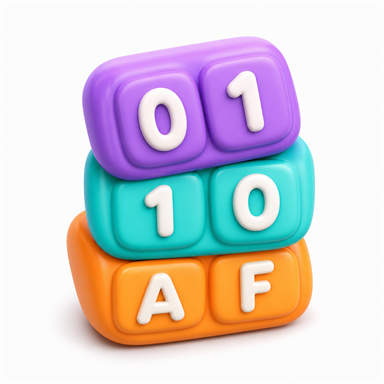
Number base converter online tool translating a value between binary, octal, decimal, and hexadecimal

Number Base Converter Online for Free

Convert integer values between binary, octal, decimal, hexadecimal, and other supported bases. Review numeric representations for programming, electronics, mathematics, and debugging.

Binary (2)

Octal (8)

Decimal (10)

Hexadecimal (16)

Why Number Base Conversion Matters

Computers represent data in binary, while developers frequently read decimal numbers and hexadecimal addresses, masks, bytes, colours, and identifiers. Octal also appears in permissions and legacy formats.

Manual conversion becomes error-prone as values grow or require repeated division and place-value calculations. The result still needs correct interpretation for signedness, bit width, prefixes, byte order, and overflow.

How Hemiley Converts Number Bases

Enter a valid number, select the source base and destination base, and run the conversion. The output represents the same numeric value using another digit set.

Support may vary for prefixes, fractional values, negative signs, and very large integers. Base conversion alone does not determine two's-complement width, endianness, character encoding, or application overflow behaviour.

Key Benefits

  • Common bases

    Translate values between binary, octal, decimal, and hexadecimal.

  • Place-value learning

    Compare how the same quantity appears in different bases.

  • Programming support

    Check flags, masks, bytes, permissions, and constants.

  • Reduced errors

    Avoid repeated arithmetic for larger integers.

  • Copy-ready output

    Use results in code comments, tests, and documentation.

  • Interpretation clarity

    Keep base conversion separate from signed-width rules.

Who Uses This Developer Tool?

  • Software developers

    Convert constants, masks, bytes, and identifiers.

  • Embedded engineers

    Inspect register values and bit patterns.

  • System administrators

    Review octal permissions and hexadecimal diagnostics.

  • Students

    Learn positional notation and practise conversion.

  • QA engineers

    Prepare boundary values in several representations.

How to Convert a Number Base Online in 3 Steps

  1. 1

    Select the source base.

    Choose the numeral system used by the input.

  2. 2

    Enter the value and target base.

    Use only digits valid for the source base.

  3. 3

    Convert and verify.

    Apply any separate bit-width, sign, or prefix rules required by your system.

Common Use Cases

  • Convert a binary mask to hexadecimal.
  • Translate a hexadecimal error value into decimal.
  • Review octal file-permission values.
  • Create binary examples for digital-logic lessons.
  • Check decimal bytes against hexadecimal packet output.
  • Prepare test boundaries in several numeral systems.

Why Choose Hemiley?

Hemiley provides a direct way to compare common numeral systems without manual place-value arithmetic.

The converter does not infer data type, signedness, bit width, byte order, floating-point representation, character encoding, or overflow behaviour.

Frequently Asked Questions

A base determines the available digits and the place value of each position.

A through F represent decimal values ten through fifteen.

Use the supported sign option when available; fixed-width two's-complement is a separate interpretation.

They are common programming prefixes for binary and hexadecimal values.

Only when the tool explicitly supports fractions; repeating values may require rounding.

Meaning depends on type, signedness, bit width, byte order, and context.